
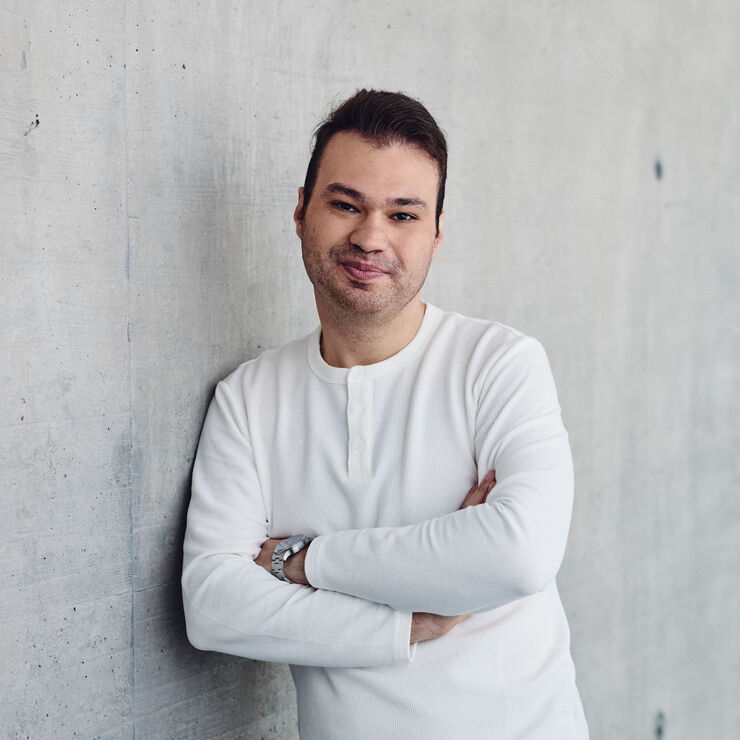
In computer engineering, I learned to fix errors. In neuroscience, I learned to listen to them — because in the brain, an error isn’t a bug. It’s how we learn.
Amir Harris
We learn from our mistakes, but how? During my MSc studies, I first explored this question by modeling how people learn from feedback. Yet nothing informs a model of the brain like the brain’s own signals, so at ICPBR, I studied error signals in the macaque medial frontal cortex. My PhD now combines neural recordings with biologically constrained multi-regional RNN models. Having seen the impact of neurodegenerative and psychiatric conditions firsthand, I am motivated to understand how the brain monitors errors to guide behavior and how these monitoring and learning processes may be altered in psychiatric disorders such as schizophrenia.
In computer engineering, I learned to fix errors. In neuroscience, I learned to listen to them — because in the brain, an error isn’t a bug. It’s how we learn.
Present Positions And Title
PhD Student
Research Group
Email Address
Career
| Period | Institution | Role |
|---|---|---|
| Since 2026 | Hertie Institute for AI in Brain Health, University of Tübingen | PhD Student |
| 2025 – 2026 | International Center for Primate Brain Research (ICPBR), Chinese Academy of Sciences, Shanghai | Research Assistant |
| 2021 – 2025 | School of Cognitive Sciences, Institute for Research in Fundamental Sciences (IPM), Tehran | Research Assistant |
Academic Education
| Year | Degree | Institution | Field of Study |
|---|---|---|---|
| 2022 | M.Sc. | Shahid Rajaee University, Iran | Computer Engineering – Artificial Intelligence |
| 2018 | B.Sc. | Qom University of Technology, Iran | Computer Engineering – Software Engineering |